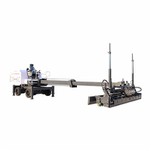
When most people think of concrete floors, they envision perfectly flat, level surfaces. While this is the standard for warehouses, distribution centers, and many industrial applications, there is an equally critical category of concrete work that demands the opposite: precise slope. From parking decks and drainage channels to airport aprons and ramp structures, controlling grade in one or two directions is essential for functionality, safety, and compliance.

For contractors taking on these projects, the question is not whether the floor can be sloped, but how accurately and efficiently that slope can be achieved. This is where modern laser screed technology, equipped with advanced slope control capabilities, has transformed what was once a painstaking, error-prone process into a streamlined, high-precision operation.
Understanding Slope Control: Single Slope vs. Dual Slope
Slope control on a laser screed refers to the machine's ability to maintain a consistent, angled plane rather than a level plane. This can be broken down into two categories:
Single Slope: The screed maintains a consistent fall in one direction (e.g., 2% slope toward a drain), while remaining level in the perpendicular axis. This is common in simple drainage applications, parking lots, and walkways.
Dual Slope (Compound Slope): The screed simultaneously maintains two independent slopes-typically one along the length of the pour and another along the width. This is required for more complex geometries like aircraft aprons, loading docks, or floors designed with drainage channels that slope in two directions.
The Technology Behind the Slope
Achieving precise slopes manually-using traditional string lines, grade stakes, and hand-operated equipment-is slow, labor-intensive, and prone to human error. Modern laser screeds address this by integrating digital slope control into their guidance systems.
The operator simply inputs the desired slope percentages (e.g., 1.5% in the X-axis and 0.75% in the Y-axis) directly into the machine's control panel. The system, working in concert with the laser receiver and grade sensor, then continuously and automatically adjusts the screed head's elevation to maintain that exact plane throughout the entire pour-whether the machine is moving forward, turning, or working in sections. The result is a consistently sloped surface that meets stringent specifications without constant manual intervention.
Where Slope Control Matters Most
Parking Structures: Require precise slope for drainage, often with complex transitions between ramps and flat decks.
Aircraft Hangars & Aprons: Demand exceptionally accurate slope to guide rainwater away from aircraft while maintaining safe, level surfaces for ground support equipment.
Industrial Freezers & Coolers: Often incorporate floor drains and sloped floors to manage condensation and wash-down processes.
Food & Beverage Facilities: Require precise sloping to ensure sanitation water flows to drains, preventing pooling and contamination risks.
Sports Facilities: Indoor arenas, ice rinks, and multi-purpose venues often incorporate sloped floors for drainage or spectator sightlines.
The Operational Advantage
For contractors, the ability to quickly and accurately execute sloped pours translates directly into business value:
Reduced Labor: Automated slope control eliminates the need for multiple grade checkers and manual adjustments, allowing crews to focus on finishing quality.
Faster Cycle Times: Setting slope parameters once at the start of the pour means continuous, uninterrupted operation, significantly speeding project completion.
Eliminated Rework: Precision slope from the first pass reduces the likelihood of ponding water or out-of-spec conditions that require costly corrective overlays.
Conclusion: Slopes Made Simple
Modern laser screed technology has taken the complexity out of slope work. What once required skilled crews with levels, strings, and constant verification can now be accomplished with a few keystrokes and a machine that self-corrects in real time. For contractors who regularly face drainage requirements, parking decks, or specialty industrial applications, a laser screed with robust slope control capability is not just a tool-it's a competitive advantage.
At Mtecix, we design our HA-Series laser screeds with dual-slope capability as a core feature. Whether the job calls for a dead-level warehouse or a complex, multi-directional drainage plane, our machines are engineered to deliver precision-automatically, efficiently, and reliably.