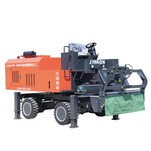
Floor grinders are essential professional equipment in modern floor treatment projects, widely used for grinding, polishing, and refinishing surfaces such as concrete, stone, and epoxy floors. Their efficient and precise operation makes them a key tool for floor construction in industrial plants, commercial spaces, and public facilities. Understanding the working principle of a floor grinder will help you better select and use this equipment, improving construction efficiency and quality.
The core operating principle of a floor grinder is to apply pressure to the floor surface through a high-speed rotating grinding disc. The friction between the abrasive discs or blocks on the disc and the surface removes material or creates a surface finish. The equipment is typically equipped with one or more motors that drive the grinding discs at speeds of thousands of revolutions per minute. Abrasive discs of varying grit sizes can be mounted on the discs, enabling a range of grinding operations from coarse to fine, completing processes such as leveling, decontamination, screeding, and polishing.
During operation, the operator controls the direction of the grinder's movement with a handle to ensure even coverage of the surface. The weight and pressure system of the grinder significantly influence the grinding effect. Some machines utilize a deadweight-driven design, relying on the machine's own weight to provide a stable grinding force. Higher-end models may be equipped with hydraulic or pneumatic pressure mechanisms, allowing the operator to adjust the pressure based on the floor material and application requirements, thereby optimizing grinding efficiency and reducing material waste.
Floor grinders use a variety of grinding disc materials, with diamond discs and resin discs being common. Diamond discs, due to their extreme hardness, are suitable for coarse grinding and rapid delamination of hard surfaces like concrete and stone. Resin discs, on the other hand, are more suitable for epoxy floors or pre-treated surfaces, achieving a finer polish. Ease of changing discs is also a key consideration in equipment design. Modern grinders often utilize modular disc systems, allowing for quick adjustment of disc configurations.
Furthermore, floor grinders are often equipped with dust extraction or collection systems to reduce dust pollution during application, improve the work environment, and protect operator health. Some models also support wet grinding, which uses water to lubricate the discs, reducing frictional heat and dust, making them suitable for locations with strict dust control requirements.
In short, floor grinders, through their sophisticated mechanical design and flexible grinding system, achieve efficient and precise floor treatment. Whether for coarse grinding and decontamination or fine polishing, their operating principle revolves around the friction between the rotating grinding disc and the grinding wheel. Combined with different abrasives and pressure methods, they meet diverse construction needs. Understanding this principle helps construction companies select appropriate equipment, optimize operational processes, and improve the overall quality and efficiency of floor projects.