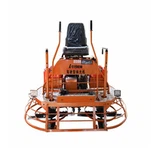
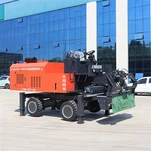
Concrete laser screed machines are essential and efficient equipment in modern construction, widely used in large-scale floor construction applications such as industrial plants, warehouses, and commercial plazas.Their core advantage lies in their high-precision leveling achieved through laser technology, significantly improving construction efficiency and floor flatness. Understanding their structural components will help you better understand their operating principles and application value.
The main structure of a concrete laser screed machine typically consists of five core components: the frame system, laser guidance system, leveling head, travel mechanism, and control system.
The frame system is the machine's supporting framework, welded from high-strength steel to ensure stability in heavy-duty construction environments. The frame design must balance lightweightness with durability to withstand long-term operation.
The laser guidance system is the "eyes" of the machine, consisting of a laser transmitter, receiver, and sensor. The laser transmitter is typically located at a fixed location on the construction site, emitting a horizontal reference beam, while the receiver, mounted on the leveling head, monitors height deviations in real time. Sensors feed data back to the control system, automatically adjusting the height of the screed head to ensure millimeter-level accuracy.
The screed head is the core operating component of the machine and consists of a vibrating plate, scraper, and trowel. The vibrating plate compacts the concrete through high-frequency vibrations, the scraper provides initial surface leveling, and the trowel further enhances the surface finish. Some high-end models also feature an automatic leveling function that dynamically adjusts the screed pressure based on surface conditions.
The travel mechanism typically uses a tracked or wheeled design to ensure stable movement on soft or uneven surfaces. Tracked structures provide enhanced grip and are suitable for large construction sites, while wheeled structures offer greater flexibility and are suitable for small and medium-sized projects.
The control system is the "brain" of the machine, integrating hydraulic adjustment, laser feedback, and an operator panel. Modern laser screed machines often utilize intelligent control technology, supporting manual and automatic mode switching. Operators can adjust parameters in real time through the control panel to optimize the finish.
The precision structure of concrete laser screeds makes them a powerful tool for floor construction, improving efficiency and significantly reducing labor costs. As the construction industry's requirements for precision increase, the market demand for this type of equipment continues to grow, and future technological upgrades will further promote its intelligent development.