

Improving the spreading quality of an emery spreader is crucial for achieving high - quality and efficient surface finishing in various construction and industrial applications. As a well - established emery spreader supplier, we understand the significance of this aspect and have accumulated a wealth of knowledge and experience over the years. In this blog, we will share some effective strategies and techniques to enhance the spreading quality of an emery spreader.
Understanding the Emery Spreader
Before delving into the methods of improving spreading quality, it is essential to have a basic understanding of how an emery spreader works. An emery spreader is a specialized equipment used to evenly distribute emery particles or other abrasive materials on a surface. It typically consists of a hopper to hold the emery, a spreading mechanism, and a power source. The spreading mechanism can be a rotating disk, a vibrating chute, or other designs, which are responsible for dispersing the emery in a controlled manner.
Selecting the Right Emery Material
The quality and characteristics of the emery material play a vital role in the spreading process. Different applications require different types of emery, such as aluminum oxide, silicon carbide, or zirconia alumina. When choosing the emery, consider factors like particle size, shape, hardness, and density.
For example, finer particle sizes are suitable for applications where a smooth finish is required, while coarser particles are better for heavy - duty abrasion. The shape of the particles can also affect the spreading pattern. Angular particles tend to provide more aggressive abrasion, while rounded particles may result in a more uniform spread.
In addition, ensure that the emery is free from impurities and has consistent quality. Poor - quality emery can clog the spreading mechanism, leading to uneven spreading and reduced efficiency.
Calibrating the Spreader
Proper calibration of the emery spreader is essential for achieving accurate and uniform spreading. The calibration process involves adjusting the spreading rate, width, and pattern according to the specific requirements of the project.
To calibrate the spreading rate, you need to determine the amount of emery that should be spread per unit area. This can be calculated based on the type of surface, the desired abrasion level, and the characteristics of the emery material. Use a weighing scale to measure the amount of emery dispensed over a known area and adjust the settings of the spreader accordingly.
The spreading width can be adjusted by changing the position or angle of the spreading mechanism. Make sure that the width is consistent across the entire working area to avoid uneven coverage.
The spreading pattern is also an important factor. Some spreaders allow you to adjust the pattern to be either wide - spread or concentrated. Select the appropriate pattern based on the shape and size of the surface to be treated.

Maintaining the Spreader
Regular maintenance of the emery spreader is crucial for its optimal performance. Here are some key maintenance tasks:
- Cleaning: After each use, clean the hopper, spreading mechanism, and other parts of the spreader to remove any remaining emery particles. This prevents clogging and ensures smooth operation. Use a brush or compressed air to clean hard - to - reach areas.
- Lubrication: Lubricate the moving parts of the spreader, such as bearings, gears, and chains, according to the manufacturer's recommendations. Proper lubrication reduces friction and wear, extending the lifespan of the equipment.
- Inspection: Regularly inspect the spreader for any signs of damage or wear. Check the belts, hoses, and electrical connections for any loose or frayed parts. Replace any worn - out components promptly to avoid breakdowns during operation.
Operator Training
The skill and knowledge of the operator also have a significant impact on the spreading quality. Provide comprehensive training to the operators on how to use the emery spreader correctly.
The training should cover topics such as equipment operation, calibration, maintenance, and safety procedures. Operators should be familiar with the controls of the spreader and understand how to adjust the settings to achieve the desired spreading results.
In addition, train the operators on how to handle different types of emery materials and how to adapt the spreading process to various surface conditions. Encourage them to pay attention to details during the spreading operation, such as maintaining a consistent speed and height above the surface.
Complementary Equipment and Technologies
In some cases, using complementary equipment and technologies can further improve the spreading quality of an emery spreader. For example, Steeling Wheel Ride - on Laser Screed can be used to prepare a flat and smooth surface before the emery spreading process. This ensures that the emery is evenly distributed and adheres better to the surface.
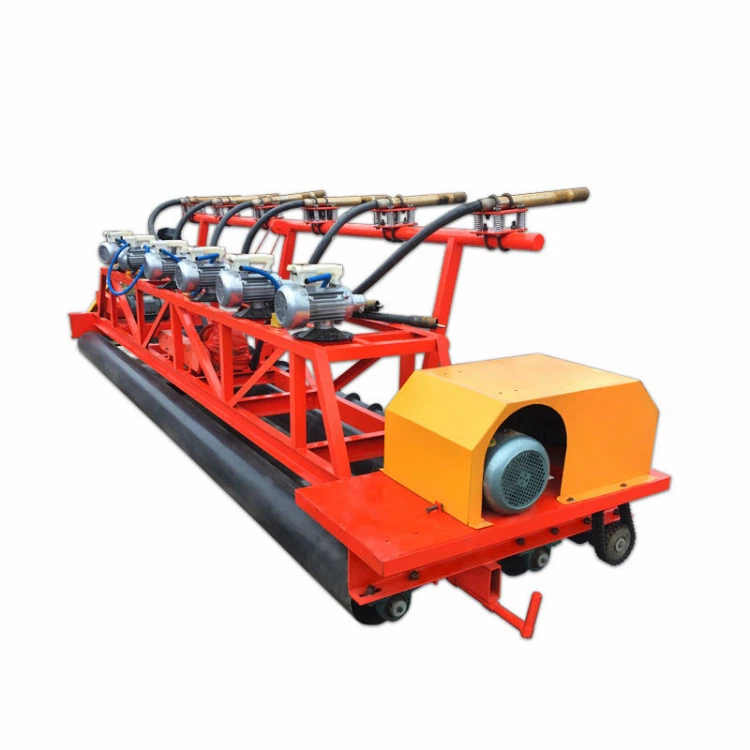
Similarly, 4 - 6m Adjustable Triple Roller Paver and 6m Hydraulic Triple Roller Paver can be used in combination with the emery spreader for large - scale surface finishing projects. These pavers can help to level the surface and provide a more uniform base for the emery spreading.
Quality Control
Implement a quality control system to monitor the spreading quality during the operation. This can include visual inspections, sampling, and testing.
Visual inspections should be carried out regularly to check for any signs of uneven spreading, such as streaks, clumps, or areas with insufficient coverage. Sampling can be done by collecting emery samples from different parts of the spread surface and analyzing their distribution and characteristics.
Testing can involve measuring the abrasion resistance and surface roughness of the treated surface to ensure that it meets the required standards. Based on the results of the quality control, make necessary adjustments to the spreading process, such as recalibrating the spreader or changing the emery material.
Conclusion
Improving the spreading quality of an emery spreader requires a comprehensive approach that includes selecting the right emery material, calibrating the spreader, maintaining the equipment, training the operators, using complementary technologies, and implementing quality control measures. By following these strategies, you can achieve more accurate, uniform, and efficient spreading, leading to better - quality results in your construction and industrial projects.
If you are interested in our emery spreaders or need more information on how to improve the spreading quality, please feel free to contact us for a detailed discussion and potential procurement negotiation.
References
- Construction Equipment Handbook, various editions
- Abrasive Materials and Their Applications, industry research reports
- Manufacturer's manuals for emery spreaders and related equipment


